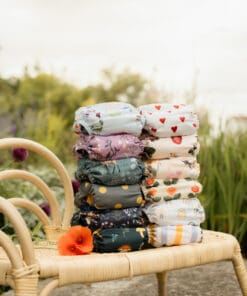
You have decided, you are ready. It is time to start use cloth diapers! You type in cloth diapers on Google and start to browse the result. Suddenly you feel a spin in the head, there are so many terms and shortenings, more than you could ever imagine. You close the browser and feel like “well not so bad using disposables after all”.
Do you recognize it?
No worries! We are here to help you! Green Poppys great guide on different systems and inserts and materials will probably help you sort out the mess in your head. Let’s get started!
So typically a cloth diaper consists of two parts, one outer waterproof shell and the inner part that has some sort of absorption.
Here are the different systems of cloth nappies we go through in the guide:
Diaper covers
Pocket diaper
AI2/SIO
All In One
Pull-up trousers
Fitted diaper
Wool socks/wool trousers
Flat diapers
Prefold
Pre-flat
Diaper covers/SIO/AI2
We’ll start by introducing pul – and, more specifically, diaper cover. Pul stands for Polyurethane Laminate and is a plastic film applied to a polyester fabric, which makes the fabric waterproof. It forms the basis of many cloth nappies and is what ensures the nappy remains leak-proof.
One diaper cover is a waterproof outer layer that you use with absorbent insert or flat diapers. It acts as a barrier that lets air through but keeps moisture in, which helps to keep the baby's clothes dry while allowing the skin to breathe. PUL is made of fabric with a thin plastic coating that makes the material waterproof, yet soft and supple.
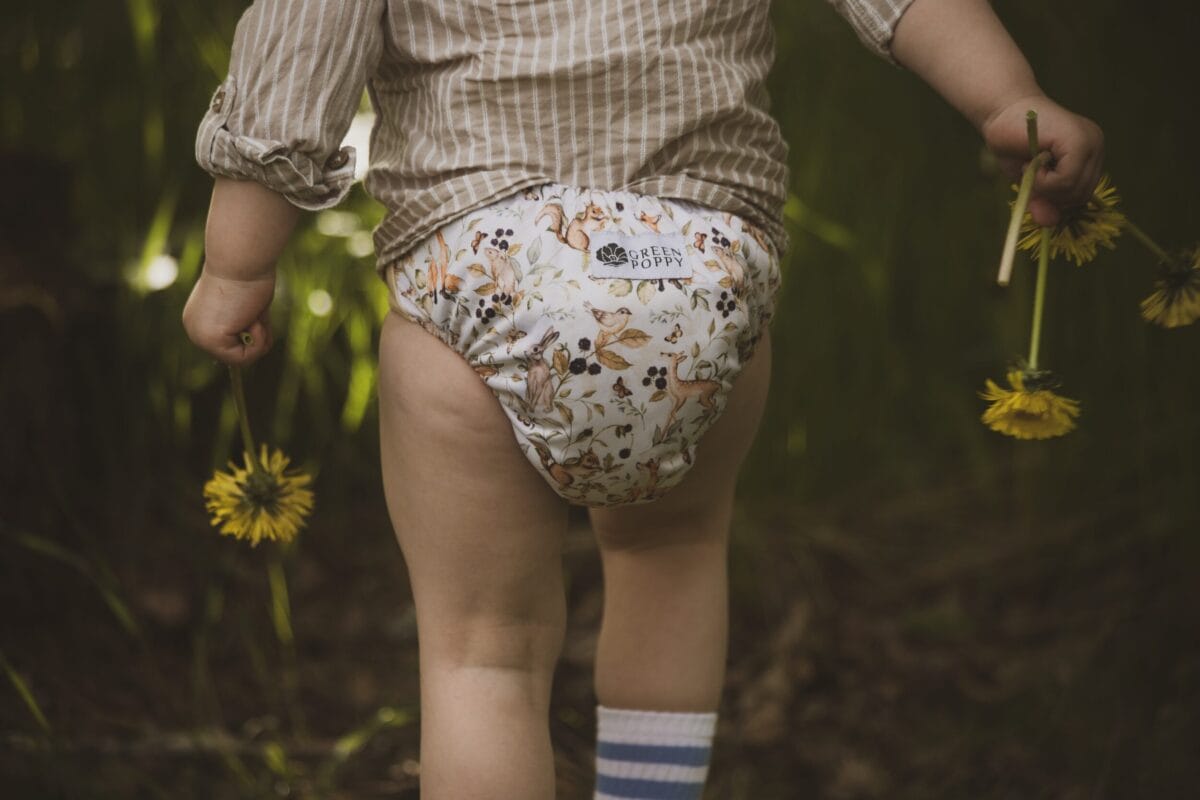
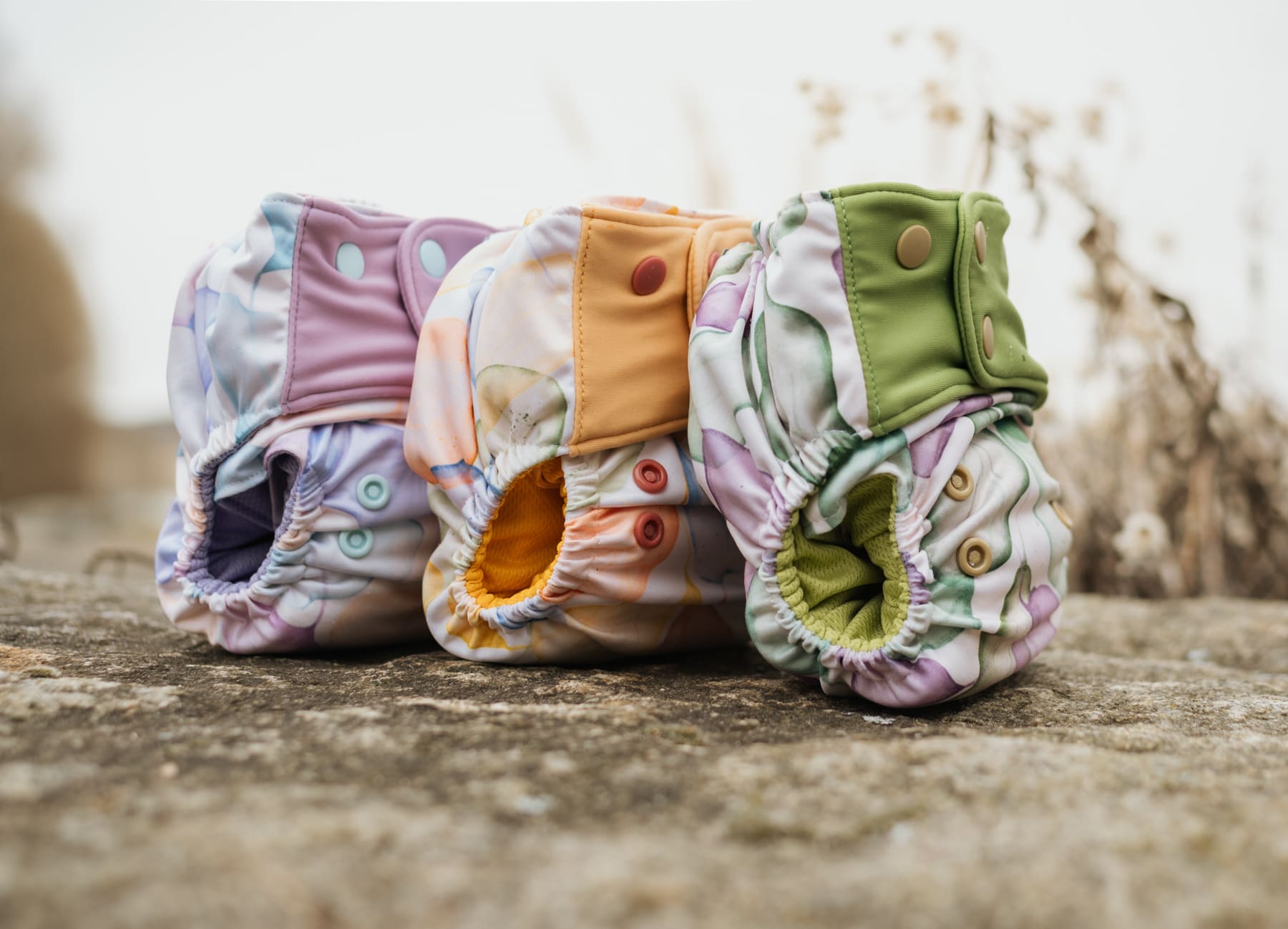
Green Poppy’s diaper cover has press studs on the inside, allowing you to easily fasten the insert so that they stay in place. There are also pockets at the front and back where you can tuck in loose insert or flat diapers pieces. When you use a diaper cover in this way, it’s called a ”Snap-In-One” (SIO) system. An SIO system means that the inläggen is secured inside the cover with press studs, which makes the nappy easier to handle, reduces the risk of the inläggen shifting and makes nappy changes easier.
A major advantage of diaper cover nappies is that you can reuse them several times before you need to wash them. If the inlägg insert gets wet, you simply replace it and continue using the cover. You wash the cover when it feels dirty or if there’s poo on it.
There is also a system called AI2 – All-in-Two. It is very similar to SIO (as mentioned above), but the difference is that the inserten is not fastened to the cover; instead, it sits loosely inside it. The name ‘All-in-Two’ refers to the fact that it is a complete nappy in two parts: a cover and a insert.
Green Poppy’s diaper cover is available in an adjustable ”one-size-fits-all” design that can be adjusted using buttons to ensure it fits for a longer period of time.
Pocket diapers
Pocket diapers consists of a waterproof diaper cover layer and an absorbent insert layer. The outer layer itself does not absorb liquid, but there is a pocket on the inside where you can insert loose insert inserts. This makes it easy to adjust the nappy’s absorbency by adding more or fewer insert inserts as required.
The inside of the pocket, meaning the part closest to the baby's skin, is made either from natural material or a stay-dry material. Natural materials, such as cotton or bamboo, absorb quickly and make the baby feel wet when they wee, which can aid in potty training. A stay-dry material, such as fleece or AWJ, wicks moisture away from the skin, providing a drier feel which can be more comfortable for the baby.
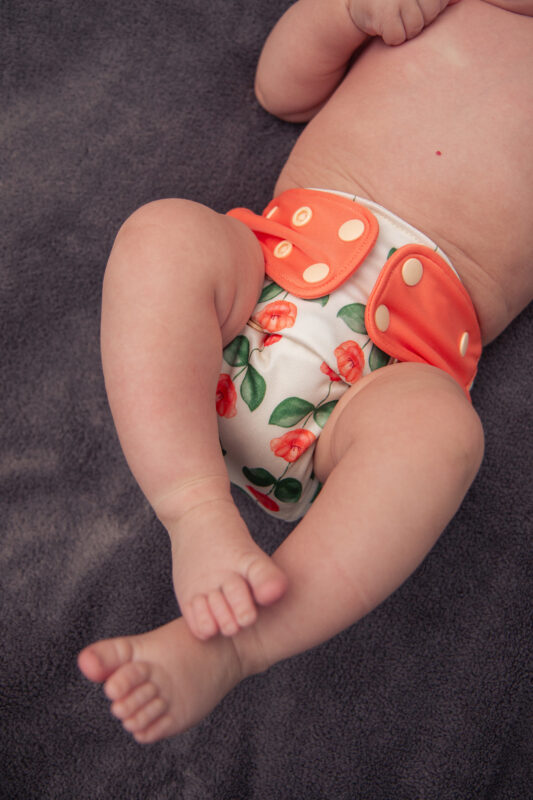
As the insert is inside the pocket, you change the entire nappy – both the outer cover and the insert – at every nappy change. This makes pocket nappies just as easy to use as disposable nappies, but they are a more sustainable option. Green Poppy offers pocket nappies in an adjustable ”one-size” design that grows with your child, with the size adjusted using the buttons on the front of the nappy.
All In One
All In One – all in one. This product is not available to buy from Green Poppy, but we’d still like to mention it. The outer layer consists of a waterproof shell made of pul (polyurethane laminate) and an absorbent insert layer. In AIO can have all absorbent material sewn into the shell and this is most like a disposable nappy. You change the entire nappy with wee or poo and everything is washed in one piece. The disadvantage of an AIO is that it has a very long drying time as the absorbent material is sewn into the PUL.
Pull-up trousers
A pair of loose-fitting trousers made from pul. These are worn over various types of nappies or insert. They usually have cuffs around the waist or legs. Available in fixed sizes only.
Below is an overview of some of the different systems available.
Wool pants
A pair of soft pants made of wool. You place them over different types of diapers and inserts. Wool needs to be lanolised to be used as a waterproof barrier (you can read more about that here). Wool is an anti-bacterial, thermoregulating and breathable material. You wash the wool after contact with poo or when the wool starts to feel unfresh (usually around every 3-6 weeks). Comes in many different sizes.
Wool cover
A soft diaper cover made of wool. Puts over different types of diapers and inserts. Also need lanoline to be waterproof. Some wool diaper covers come in one size and the size will be regulated with snaps. Other wool diaper covers are sized.
And most often a slightly bulkier nappy, where the entire nappy consists of absorbent material. This nappy requires a waterproof cover on the outside to prevent leaks. Shaped nappies are available with or without a stay-dry layer. These are often used at night but can just as easily be used during the day. The entire nappy is washed when soiled. Available in fixed sizes and one size.
A large square piece of fabric. Standard sizes are 60×60 cm or 70×70 cm. Often made of cotton (muslin) but also available in other, more absorbent materials such as bamboo. In a baby shop, you can find these as muslin blankets, but they work perfectly well as nappies. This is the cheapest system when it comes to cloth nappies. A flat diaper can be folded in various ways around the baby. A flat diaper requires a waterproof cover on the outside.
Pre-flat
Similar to a flat diaper but usually slightly more absorbent. May consist of several layers of fabric. Has a different shape to a flat diaper, and many people say it is easier to use as it can only be worn one way. Requires a waterproof cover. Available in many different sizes.
Prefold
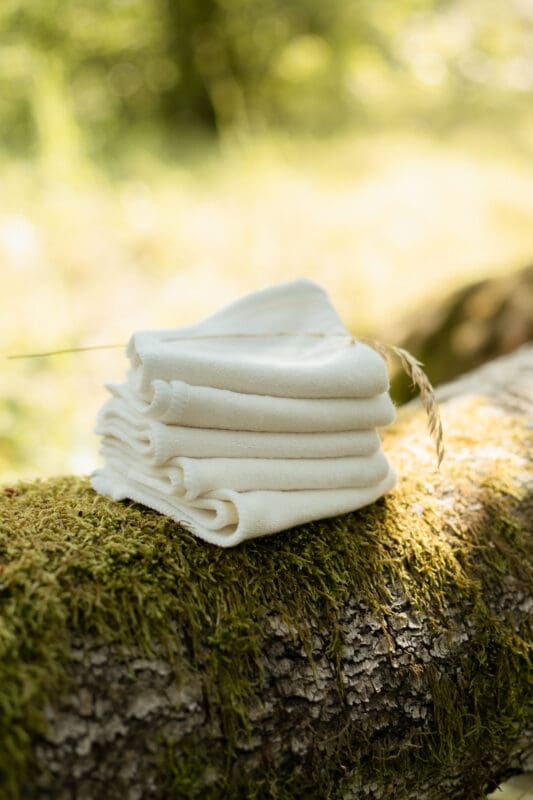
It’s like a thicker and slightly larger version of the insert. It usually has markings showing how to fold it so that it fits neatly into a case. You fold this into a long rectangle. It comes in many different sizes. Green Poppy stocks one thinner (for daytime) and one thicker model (for night-time/heavy wetters or when changes are further apart).
Inserts for cloth nappies
There are more inserts and combinations of inserts than possible to count to. You will need to try a few inserts to see what the perfect fit for you and your baby is. The most common fabrics for inserts are microfiber, cotton, bamboo and hemp.
Microfibre.Absorbs the fastest but holds the smallest amount of fluids. You usually puts this type of insert at the top – but nere directly to the baby’s skin. These inserts helps to capture the fluids and the spread it out to the layers beneath it. It is possible though for the insert to act like a sponge and let out fluids if there is pressure to it.
Cotton.Have a fast absorption time, but not as fast as microfiber. Cotton is better at retaining fluids than microfiber. Cotton is made on natural fibre. Cotton is common to have as the first layer of inserts, it can also be in contact with the baby’s skin.
Bamboo.Absorbs slower than cotton but can contain a greater amount of fluids than both cotton and microfiber. Is common as a middle layer or in combination with cotton.
Hemp.Absorbs the slowest of all fibres, but can at the same time hold the most amount of fluids. Is usually put as the bottom layer of insert. Common fabric for boosters. Can with advantage be used during night time or when you want to change the diaper more rarely.
A schematic overview of the different absorption times and quantities of inlägg. Ju more watches, the more longer The time it takes for the material to absorb liquid. The more drops the sea the amount of liquid the material can hold. The arrows show the order in which the material should be positioned in relation to the child (top, middle or bottom).
Stay dry liners
The main purpose of dry liners is to keep the baby dry when peeing. They usually don’t consist of any absorbing fabrics, but there are a few on the market that does both. Dry liners can be sewn in to the diaper or look like an insert. Here at Green Poppy, we sell dry liners made of AWJ (athletic wicking jersey/coolmax) or micro fleece. You put the dry liner as the top layer, closest to the baby’s skin. There are also dry liners made of wool and silk.
Does it feel a little clearer now with all the different systems out there? Or do you still have any questions? Please contact us!
Green Poppy is collaborating with Blöjupproret. There, you can also read more about different nappy systems or the insert method.
Still unsure about how cloth nappies work? Feel free to take a look at our YouTube series where we go into depth about how cloth nappies work! You can also find short tips and clips on our Social media.
Green Poppy is run by entrepreneur and midwife Emma Kajmo, entirely from home in Eskilstuna.
Founded in 2023 during parental leave, born from a love of reusable and sustainable alternatives, Green Poppy came to life. After a few evening courses and a million Google searches (“how to start your own business”), we were up and running.